
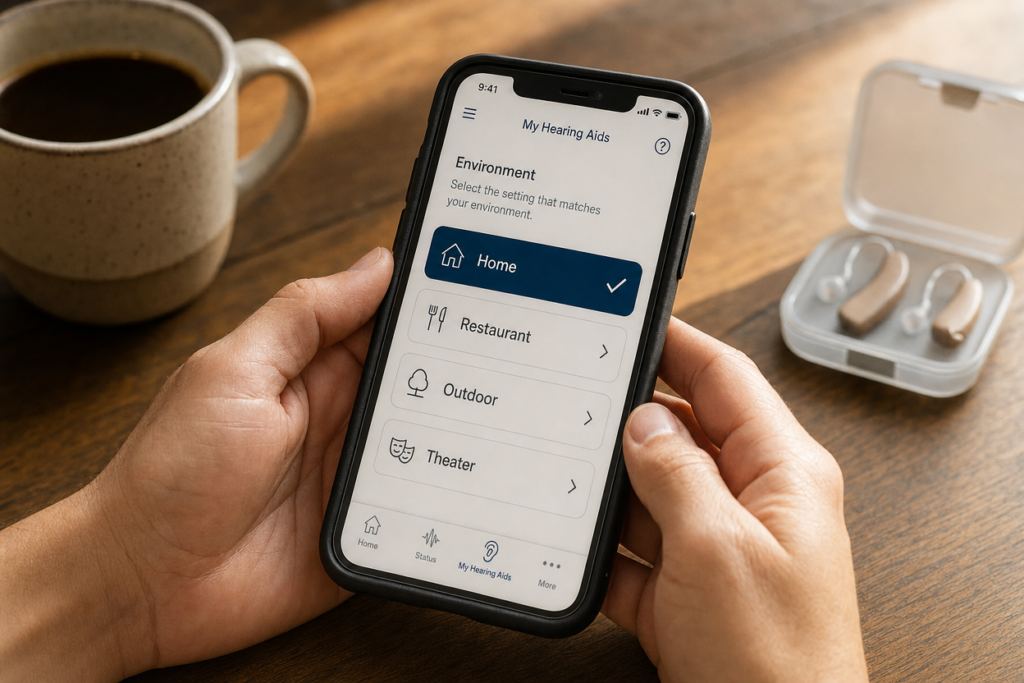
A patient asked me last month, “What does it actually mean when you say you’re going to program my hearing aids for me?” Fair question. The phrase gets thrown around a lot in this industry and it doesn’t always mean much.
Here’s what it means at The Hearing Guy. It means we take the specific places where you live your life, and we tune your hearing aids to perform in those exact rooms. Not in a generic test of “hearing aid wearers.” In your church, your car, your favorite breakfast spot, your back porch.
Let me show you what that looks like in practice.
Programs aren’t presets
Most modern hearing aids — Oticon, ReSound, Starkey, Phonak, Signia, Widex, Unitron — ship with factory presets. Default. Restaurant. Music. TV. Outdoor. They’re starting points. Each manufacturer’s research team figured out a reasonable middle ground for an average wearer in an average version of that environment.
Your life isn’t average. Your favorite restaurant might have a hard tile floor and high ceilings, which reflects sound completely differently than the carpeted dining room the preset was designed around. Your car might be a quiet sedan or a diesel truck. Your church might have a sound system, or it might be a small chapel where the acoustics are all you’ve got.
So when I say I’m going to program your hearing aids, I don’t mean I’m going to load the factory restaurant preset and call it done. I mean we’re going to take that starting point and modify it until it works in the rooms you actually go to.
How we figure out which rooms matter
It starts in our first conversation, before any device fitting. I ask what your week looks like. Where do you spend time? Who do you talk to most? When does your hearing frustrate you the worst?
The answers vary wildly. A patient who watches a lot of TV with his wife in the evening needs a TV program that handles dialogue compression well, because TV audio is mixed for people with normal hearing. A patient who teaches Sunday school needs a setting that handles a room with kids’ voices. A patient who drives a long commute needs road-noise management that the factory preset probably doesn’t get right.
Then we prioritize. Most hearing aids let us program three to four custom slots beyond the default. So we pick the environments where you spend the most time, or where you struggle the most, and we build those programs specifically for you.
What gets adjusted
When I program a “restaurant” environment for you, I’m not just turning a single knob. I’m making decisions about:
How aggressively the aids should suppress background noise. Too aggressive and you lose ambient sound — including the person sitting next to you. Too passive and the restaurant rumble takes over.
How directional the microphones should be. Tighter directionality focuses on the speaker right in front of you and rejects sound from behind. Looser directionality lets you hear the table around you. Both have a place. Depends on you.
How much gain to apply in the speech frequencies versus the lower rumble frequencies. Boost speech too much in a noisy room and it’ll sound harsh. Boost it too little and you can’t hear your spouse.
How the compression behaves when the room gets suddenly loud. A spike from a dropped plate shouldn’t blow out your hearing.
Multiply those decisions across three or four custom programs, and you start to see why this isn’t a five-minute job. A real programming session for one set of environments can take the better part of an hour. That’s normal. It’s also the part patients tell me they’ve never experienced before.
The follow-up programming nobody talks about
Here’s the piece most clinics skip. The initial programming is just the starting line.
After you wear the aids in the real world for a week or two, your brain starts to adapt. It re-sorts which sounds are signal and which are noise. It rebuilds filtering pathways that have been quiet for years. That adaptation changes what the aids should be doing.
So when you come back for your first follow-up — usually around day 7 to 14 — we don’t just check that everything’s working. We re-program based on what you’ve experienced. Restaurant was too noisy on the right side? We tighten the directionality. Wife’s voice on the back porch is still hard to catch? We boost the speech frequencies in that range.
Same thing at the day 30 visit. By then, you’ve had a month of real-world exposure and a lot of brain adaptation. The settings that felt right on day one almost certainly need to be tuned again.
And again at day 60 to 90, when the adaptation has largely settled and we’re locking in your final programs. That’s the rhythm of the Experience Hearing methodology — and it’s why our patients tell us their aids work better six months in than they did on day one. Most hearing aid wearers experience the opposite.
“Fit for your life” — concretely
If you want a single picture of what “fit for your life” means in practice, here it is.
A patient came in last fall, retired schoolteacher, big family. Her three priorities were Sunday dinner at her daughter’s house, her morning walk with a friend, and church on Sundays.
We built three custom programs for those exact three settings. Daughter’s house is a busy kitchen-living room combo with grandkids running through — so we needed strong noise management without losing the kids’ voices. Morning walks meant outdoor wind, traffic on Merrimon Avenue, and a conversation partner walking next to her, not in front of her — so directionality had to be looser and wind management had to be aggressive. Church meant a quiet sanctuary, a sound system, and an emphasis on speech clarity from distance.
She came back at day 14 and we tweaked all three. Day 30, we tweaked the church one more, because the acoustics in the sanctuary turned out to behave a little differently than I’d expected. Day 90, we locked everything in.
She told me last Christmas she hadn’t realized hearing aids could feel like part of her life rather than a piece of equipment. That’s what custom programming for specific environments is supposed to do.
Come Experience Hearing for yourself
If your hearing aids feel like a one-size-fits-all preset, they probably are. That’s fixable. We work with every major manufacturer, so chances are we can take what you already own and turn it into something fit for your actual life.
Come Experience Hearing for yourself at our Asheville office on Hendersonville Road or our Hendersonville office on South Main. Call (828) 274-6913 and we’ll get you scheduled.
— Dr. Brent Steele, MD, BC-HIS