
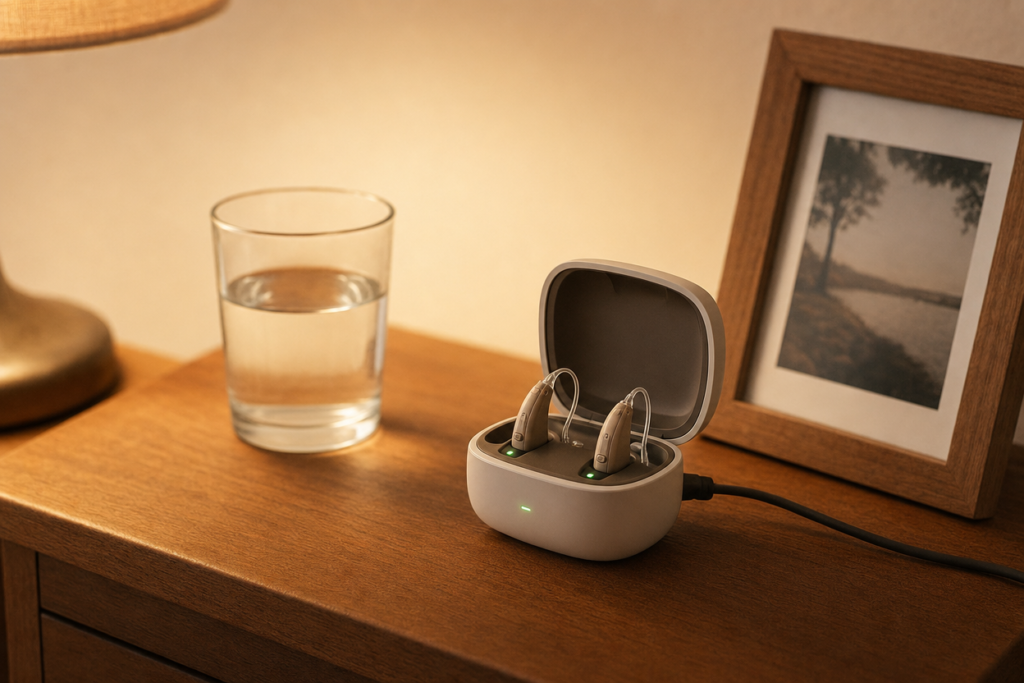
A patient last winter brought in her three-year-old rechargeable aids and asked us to “fix the battery — they only last me about ten hours now.” She was almost in tears. She’d been getting eighteen hours when she first got them, and the drop felt like the beginning of the end of the devices. Two minutes into the appointment we figured out the actual cause — she’d been storing the charging case on the windowsill above her kitchen sink. Six months of direct sunlight and stove-heat had cooked the lithium cells inside the case itself. We swapped the case (under warranty) and she got back to eighteen hours the same day.
Most battery problems aren’t device problems. They’re habit problems. The hardware in a modern hearing aid will outlast almost anyone’s expectations if you treat the batteries right. Here’s how.
Zinc-air vs. lithium — what you actually have
If you don’t know which kind of battery you have, look at the device. If you slide open a small door on the device every few days to drop in a new round battery, you have zinc-air. If you set the device into a small charging case overnight, you have lithium rechargeable.
Zinc-air batteries come in four standardized sizes, color-coded across every manufacturer:
- Size 10 (yellow) — smallest, lasts 3 to 5 days
- Size 312 (brown) — most common, lasts 5 to 7 days
- Size 13 (orange) — larger, lasts 6 to 10 days
- Size 675 (blue) — largest, lasts 9 to 14 days
Lithium rechargeable batteries are built into the hearing aid itself — you don’t see them and you don’t replace them. They deliver about 24 hours of use per full charge for most premium devices, with streaming (phone calls, music, TV) cutting that to 16 to 20 hours depending on how much you stream.
Most patients we see today are on lithium. Most patients we saw five years ago were on zinc-air. Both work. Neither is universally better. The right choice depends on dexterity, lifestyle, and what’s available for your specific hearing loss profile.
Zinc-air best practices — the part people don’t realize
Zinc-air batteries are activated by oxygen. The colored sticker on a fresh battery is a seal that keeps oxygen out until you’re ready to use it. The moment you peel that sticker, a chemical reaction begins inside the battery and it’s slowly running down whether you put it in the device or not.
Three rules will get you significantly longer life out of every battery:
Wait 60 seconds after peeling the sticker before closing the battery door. Let the battery breathe. Patients who skip this step often get a battery that delivers 70 percent of the runtime it should. One minute of patience is worth two extra days of use.
Store batteries at room temperature, in their original blister pack. Not the bathroom (humidity activates them prematurely). Not a hot car or a sunny windowsill (heat shortens shelf life). Not the freezer (the old wives’ tale — it doesn’t help and the condensation when you take them out can damage them). A drawer in your bedroom or kitchen is perfect.
Don’t buy more than a six-month supply at once. Zinc-air batteries don’t last forever even in their unopened blister packs. A pack that’s three years old will deliver maybe 60 percent of fresh-battery runtime. We stock fresh batteries in the office and we’ll only sell you what you’ll use in a reasonable timeframe.
If your zinc-air aids start eating batteries faster than they used to — say you used to get six days and now you’re getting four — it’s not always the batteries. The device may be working harder because of a wax filter issue, a moisture issue, or a programming issue. Worth bringing in.
Lithium rechargeable best practices
The lithium battery inside your modern hearing aid is designed to last three to five years of daily use before it starts to noticeably degrade. Some patients get more. Some patients get less. The habits below are what separate the two.
Charge fully every night. Lithium batteries do NOT have the “memory effect” of older battery chemistries — you don’t need to drain them all the way down before recharging. In fact, full discharges are harder on lithium than partial ones. A nightly full charge is the right rhythm.
Don’t leave them in the charger for days at a time. If you’re going to be away from your aids for a week — say you’re on vacation and brought a backup pair — pull them out of the charger after they reach full, then turn them off. Storing fully charged at room temperature is fine. Storing fully charged AND continuously trickle-charging is hard on the cells.
Keep the charger out of heat and direct sunlight. This is the windowsill story. Hot kitchens, sunny rooms, the dashboard of a car — all of these damage the lithium cells in the case and the hearing aids themselves. A bedroom nightstand or a quiet drawer is ideal.
Wipe the charging contacts on the hearing aids weekly. A dry microfiber cloth, ten seconds per aid. Skin oil, earwax dust, and humidity build up on the small metal contacts and slowly reduce charging efficiency. If your aids ever fail to fully charge overnight, that’s the first thing to check.
Streaming, Bluetooth, and what eats your battery
If you stream phone calls, music, podcasts, or TV audio directly to your hearing aids, you’ll see a noticeable drop in daily runtime. A common pattern:
- Conversation-only use — 20 to 24 hours per charge
- Two hours of phone calls per day — 18 to 22 hours per charge
- Heavy streaming (4+ hours of music, TV, podcasts) — 14 to 18 hours per charge
This is normal. If you’re a heavy streamer, plan for it. Charge during dinner, charge during your afternoon TV time, charge whenever the aids are out for a meal. Most modern chargers will top off the case in 30 to 45 minutes.
For more on the Bluetooth side of this, see our Bluetooth and smartphone connection guide.
WNC-specific battery issues
Our climate creates two recurring battery complaints we see every year.
Summer humidity and zinc-air batteries. The chemistry that powers a zinc-air battery is sensitive to ambient humidity. From May through September, expect your batteries to run one to two days shorter than they do in winter. Not a defect. Just physics. Store the unopened blister packs in a dry kitchen drawer, not the bathroom.
Cold-weather lithium runtime drops. If you spend long hours outside in 30-degree weather in December and January — hiking, hunting, walking the dog — you may see your daily runtime drop from 22 hours to 16 or 17. Lithium cells lose efficiency in the cold. They recover when the device warms back up. If you’re going to be out for hours, bring the charging case in your jacket pocket as a hand-warmer-slash-battery-bank.
When to bring batteries up at your next visit
A few signs that battery behavior is telling you something the device needs checked:
- Daily runtime has dropped by 30 percent or more over the last few months
- One hearing aid drains noticeably faster than the other
- The aid powers off unexpectedly even when you’ve been streaming lightly
- Charging takes longer than it used to (a full charge used to take 2 hours, now takes 4+)
- The charging case itself isn’t holding its own charge well
Any of these are worth ten minutes in the office. We can test the actual current draw of the device and tell you whether it’s the battery, the receiver, or just how the device is being used.
Come Experience Hearing for yourself
If your batteries aren’t doing what they should — or you’re not sure whether you’re getting the runtime you paid for — come in. We’ll test your aids, check the charger, swap your wax filters while you’re here, and send you out with fresh supplies. Read the full living-with-hearing-aids guide for everything else.
Come Experience Hearing for yourself — call (828) 274-6913 to schedule at our Asheville or Hendersonville office. We carry fresh batteries in every size and we’ll send you home with what you need.