
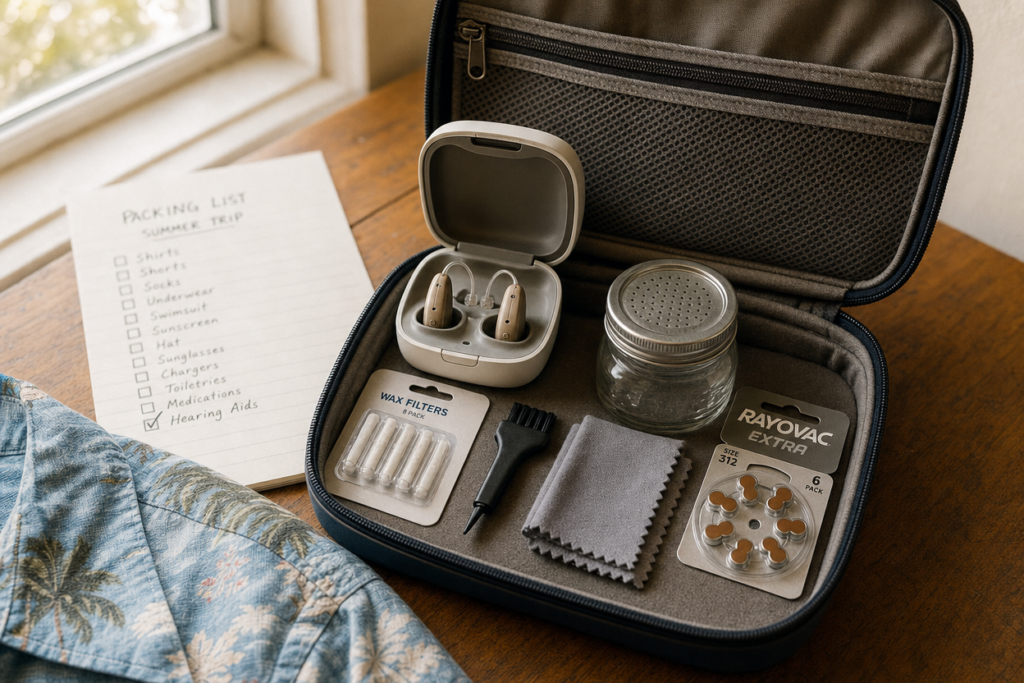
A patient stopped by the office the Friday before Memorial Day last year on her way to the airport. Her flight was at noon. At 9:30 a.m. she’d opened her travel bag, found one charger and no spare wax filters, and remembered she was about to spend ten days on a Croatian island with her grandkids. We sent her out the door at 9:50 with a kit, a hug, and a working phone number for any troubleshooting from across the Atlantic.
Most of our patients travel more than they did five years ago. Cruises, lake houses, weddings, fishing trips, road trips down to Florida or up to Maine. Your hearing aids should make every one of those trips better — not be a thing you worry about. The trick is the packing list and a few habits you build BEFORE you walk out the door.
What to pack — the kit that lives in your suitcase
If you build this kit once and leave it inside your travel bag, you never have to remember it again. It also takes less space than a paperback novel.
Pack two of everything that can fail. One hearing aid is fine for a weekend trip if the other quits — you’ll get through. Two of every accessory is what saves the trip.
- Charger and a backup cable — even if you wear rechargeable aids. A wall cube AND a USB-C or USB-A cable. Hotel rooms have weird outlets, and one frayed cord can end your trip.
- A backup pack of batteries in your size (10, 13, 312, or 675) if you wear zinc-air. Two packs if it’s a long trip. Pharmacies in small towns may not carry your size.
- A drying jar or small electric dehumidifier — if you wear lithium aids, a desiccant jar is fine for travel. If you wear traditional batteries, the same jar works. We carry travel-size versions in the office.
- Wax filter replacements — your specific model. Bring at least four. We can put a small refill pack in a tube for you on your way out of town.
- A cleaning brush and a soft microfiber cloth — the cleaning tools that came with your aids. If you’ve lost them, ask us for replacements.
- Your hearing care provider’s office card — with our phone number — (828) 274-6913. If something goes wrong, we can often troubleshoot over the phone or coordinate with a local provider wherever you are.
- Your hearing aid case — the original, not a Ziploc bag.
That’s the whole kit. Build it once. Toss it in the suitcase. Done.
Two days before you leave — the pre-trip check-up
This is the habit that prevents 90 percent of travel headaches. Two days out, do a five-minute review at the kitchen table.
Test both hearing aids on a fresh battery or a full charge. Listen for clarity in both ears. Run through a soft sound (a clock ticking), a normal sound (someone speaking in another room), and a louder one (the TV at normal volume). If anything sounds different from a week ago — call us.
Change your wax filters. Do not travel with old wax filters. They’re tiny, they cost a few dollars, and they’re the single most common reason a hearing aid sounds “weak” three days into a trip when you’re 800 miles from home.
Check your domes. If they look discolored, cracked, or stretched, replace them. If you don’t have spares, swing by — we’ll set you up.
Charge any rechargeable aids and the charging case to 100 percent. Most travel chargers will hold three to five full charges in the case itself, which means you can go a couple of days on a plane or in a car without finding an outlet. Don’t waste that capacity by leaving home with a half-full case.
For more on getting the longest life from your devices, see our battery and charging best practices guide.
Flying with hearing aids — the airport part
Hearing aids stay IN your ears through TSA. You do not have to remove them for the metal detector or the body scanner. Tell the agent you’re wearing them if they ask; otherwise just walk through. Same rule for cochlear implants and most assistive devices.
You do NOT have to put them in the bin. In fact, don’t — the bins are filthy and the conveyor belts have damaged plenty of devices over the years.
On the plane, they work like normal. Bluetooth streaming to your phone for music or podcasts works fine — most newer aids have an “airplane mode” you set through your phone’s hearing aid app, which keeps them connected to your phone but disconnects the wireless ear-to-ear link if it interferes with cabin systems (it almost never does).
If the cabin pressure makes your ears uncomfortable, the hearing aids will not cause or worsen that. You can leave them in for the whole flight.
Beach, lake, and pool — when to take them out
WNC patients spend summers on water more than most. Here are the rules.
- Lake Lure, Lake James, Fontana, the French Broad — take them out before you get in the water. Period. Lake water is harder on devices than tap water.
- Hilton Head, Charleston, the Outer Banks, anywhere with surf — take them out before you swim. Sand and salt are devastating to hearing aid microphones.
- Pool decks, boats, kayaks — keep them in. You want to hear voices, motors, traffic on the water. Wipe them down at the end of the day.
- Cruise ships — keep them in 95 percent of the time. Take them out for pool swimming and for steam-room or sauna excursions.
Bring the drying jar. Hotel humidity plus your day in the sun is exactly the moisture cocktail we wrote about in our summer care guide — your jar fixes it overnight.
Road trips, cabins, and the lower-tech version
If you’re spending a week at a family cabin in the mountains or driving the coast, you don’t need anything fancy. The same kit. The same nightly drying routine. The same wax filter changes mid-trip if your aids start sounding muffled (it’s almost always the filter).
What’s different on a longer trip — you’ll be in environments your aids aren’t programmed for. A new restaurant, a different family living room, a screened porch with crickets. If you have a smartphone app for your hearing aids, take 30 seconds to switch programs (most aids have a “restaurant” or “outdoor” setting). If you don’t use the app and you’ve forgotten how, call us — we’ll walk you through it. Three minutes on the phone, problem solved.
Special trips that deserve a phone call beforehand
Some trips are worth a 5-minute check-in with us before you go. We’d rather get the call in advance than the panicked one from a hotel lobby.
- A cruise of more than a week
- International travel, especially anywhere humid (Caribbean, Southeast Asia, Central America)
- Hiking trips at high altitude or in extreme cold
- Trips where you’ll be far from any hearing care office
- Anything where your hearing aids are mission-critical (a wedding where you’re giving a toast, a reunion, a job interview)
We’ve troubleshot patient devices from Spain, Alaska, and a deer camp in Montana. Distance isn’t the problem. Not planning for it is.
Come Experience Hearing for yourself
If you’ve got a trip coming up and your hearing aids haven’t been checked in a year — bring them in. We’ll clean them, change the filters, top off your supplies, and send you out the door knowing they’ll work as well on day eight of your trip as they do on day one. Read the full living-with-hearing-aids guide for everything else.
Come Experience Hearing for yourself — call (828) 274-6913 to schedule at our Asheville or Hendersonville office. Stop in any time. We’d love to send you off prepared.