Here’s a question I get asked less often than I should: “How many hearing aid brands do you actually fit?”
It’s the question that would have saved me a lot of grief a decade ago, before I started this practice. And it’s the question I wish more patients walked into a hearing clinic ready to ask.
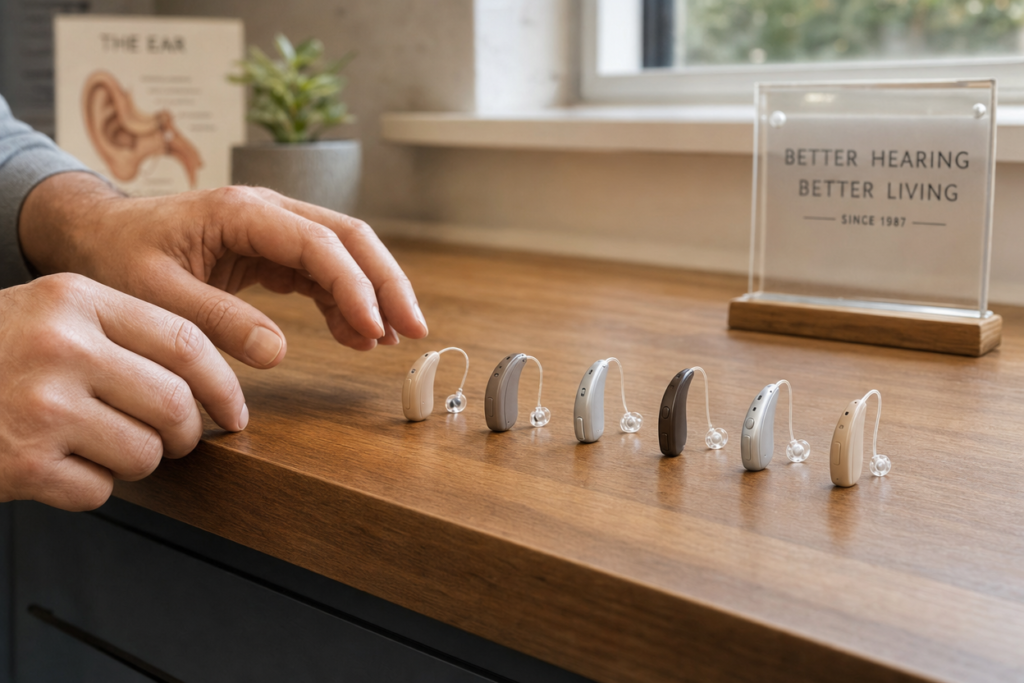
The answer at our clinic is seven. We fit Oticon, ReSound, Starkey, Unitron, Phonak, Signia, and Widex — every major manufacturer making hearing aids in the United States. That isn’t a marketing line. It’s the reason I’m able to do my job the way I think it should be done.
Let me explain why this matters more than the spec sheets ever will.
The dirty secret of brand-limited clinics
A lot of hearing clinics fit one brand. A few fit two. Some advertise that they fit “all the major brands” and, when you actually look, they really mean two or three, with one of those brands accounting for nine out of ten of their fittings.
There are usually two reasons for this. One: the clinic is owned by a hearing aid manufacturer — directly or indirectly. Two: the clinic has a long-running volume agreement with one manufacturer that makes single-brand prescribing financially obvious for the practice, even if it isn’t always clinically obvious for the patient.
I’m not throwing stones here. Brand-limited practices exist for understandable business reasons. The problem is that the patient sitting in the chair has no idea this is happening. They assume the device on the table is the one the provider believes is best for them. Sometimes that’s true. Sometimes it’s the only one the provider can actually offer.
If this whole topic is new to you, the independent vs corporate piece is a good companion read.
What changes when your clinic carries every major brand
The conversation in the room changes completely. I’m not selling around a constraint anymore — I’m trying to find the right match.
Each major manufacturer has real strengths. Phonak does remarkable work in noisy environments and has the strongest waterproofing in the market. Oticon’s open-sound approach handles speech-in-crowd situations beautifully for the right kind of hearing loss. ReSound has excellent connectivity for people who live on their phones. Starkey leads on rechargeable custom-fit work. Widex tends to do really well with music. Signia has a very natural-sounding voice processing. Unitron offers some of the best value-tier devices.
I’m not saying any of those brands is “the best” — I’m saying each one has a profile, and that profile lines up with certain hearing patterns, lifestyles, and budgets better than others. When I have all seven on my fitting table, I can actually do the matching work. When a clinic only stocks one brand, the matching work is replaced with “this is what we’ve got.”
You shouldn’t have to settle for “this is what we’ve got.”
What your hearing loss actually needs
Hearing loss isn’t one thing. The audiogram tells me which frequencies you’re missing and how severely. But that’s only the beginning of the conversation. Two people with nearly identical audiograms can need very different solutions.
A retired teacher who spends most of her time at home and on the phone with grandkids needs different technology than a contractor who’s on noisy job sites three days a week. A musician who wants to hear violin overtones again needs a different fitting philosophy than someone whose main goal is following dinner conversation. A patient with significant high-frequency loss may do better with one manufacturer’s compression strategy than another’s, even if the spec sheets look comparable.
These aren’t subtle differences when you’re the one wearing the devices. They’re the difference between “I tolerate my hearing aids” and “I forgot I’m wearing them.”
The only way to get the matching right is to actually try a few options. We do that here. We let patients wear demo units in real environments — the Experience Hearing methodology is our way of testing how a device actually performs in your life, not just in a quiet booth. If the first brand we try doesn’t feel right, we try another. That’s only possible because we carry the whole field.
How to tell what a clinic actually fits
If you’re shopping around — and you should — here’s how to find out what brand range a clinic really offers.
Ask outright on the phone: “How many manufacturers do you fit, and what are they?” Listen for a real list. “All the major ones” without naming them is a non-answer. So is “we fit whatever the patient needs” without specifics. A practice that fits seven brands can name seven brands.
Look at the wall and the desk when you walk in. Brand-limited clinics tend to have a lot of merchandise from one manufacturer — posters, brochure displays, branded mugs. Independent practices tend to look brand-neutral by design.
Check the websites. Many clinics list “products” or “manufacturers” pages. Count what’s there. If you only see one or two brand logos on a clinic that claims to fit “all major brands,” your bullshit detector is correct.
Ask about your specific brand if you’ve researched one online. If the answer is a quick “we don’t carry that” with no offer to help you think it through, that’s a flag. A clinic that fits broadly can almost always talk intelligently about any brand on the market, even ones they don’t personally carry, because they’re paying attention to the whole industry.
Why I made this choice
I’ll close with the why, since it explains my whole approach.
When we started doing hearing care in Asheville in 2014, we were a single-brand franchise. The brand was fine. But I’d see patients come in and I’d know — really know — that someone else’s device was a better match for them. I couldn’t offer it. So I either had to recommend the brand I had and hope it would work well enough, or refer them elsewhere and lose the relationship.
In 2017, my wife Leslie and I broke off from the franchise and became fully independent. The whole reason was so that I could put the best device on the right person, without an asterisk. It’s the single best business decision I’ve ever made — and more importantly, it’s the right one for the people in my chair.
If you’d like to come in and see what a brand-independent fitting actually looks like, we’d love to have you.
Come Experience Hearing for yourself in Asheville or Hendersonville. Call us at (828) 274-6913 and ask for me by name.
— Dr. Brent Steele, MD, BC-HIS
The Hearing Guy